
Business Setup & Company Formation in Dubai, UAE
Starting a business in Dubai gives entrepreneurs and international companies access to one of the world’s most dynamic business environments. However, choosing the right jurisdiction, business licence and company structure can make a major difference to your costs, operations and long-term growth.
Gulf Core Services provides end-to-end business setup services in Dubai, helping entrepreneurs, investors and companies establish their presence in the UAE with greater clarity and confidence. From selecting the right company structure to licensing, visas, banking and ongoing compliance, our team supports you throughout the company formation process.
Business Setup Options in Dubai
There are several ways to establish a company in Dubai. The right option depends on your business activity, customers, ownership requirements, visa needs and future expansion plans.
Dubai Mainland Company Formation
A mainland company is suitable for businesses that want to operate directly across Dubai and the wider UAE market.
It can be suitable for:
- Professional services
- Trading businesses
- Retail companies
- Contracting businesses
- Consultancies
- Companies working directly with UAE customers
Gulf Core can assist with activity selection, trade name approval, licensing, documentation, visas and other incorporation requirements.

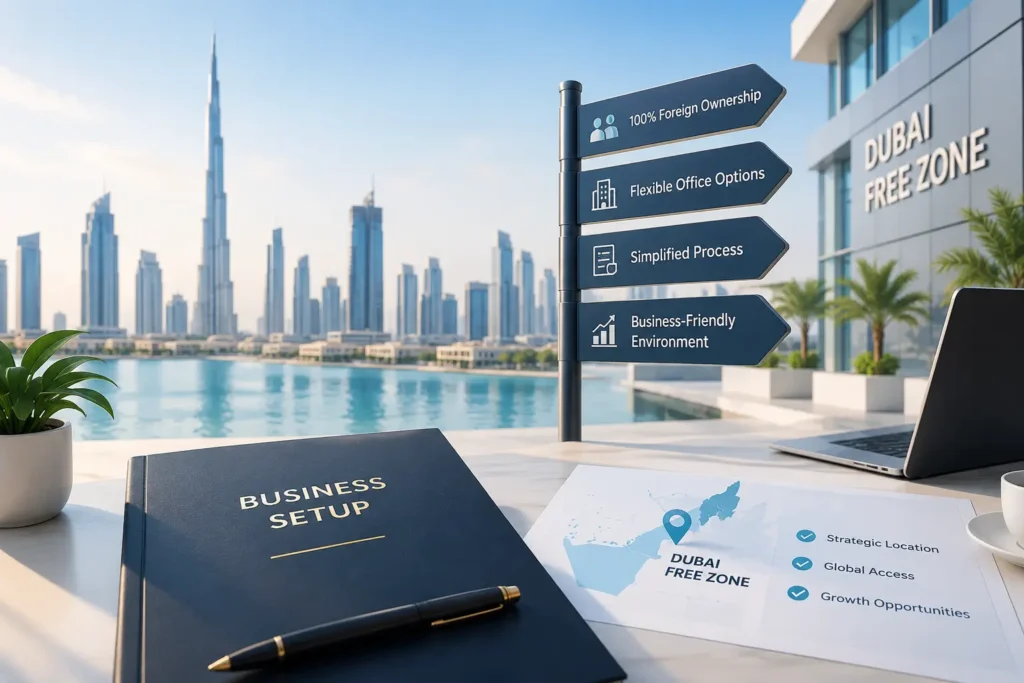
Dubai Free Zone Company Formation
Dubai has several Free Zones designed around different business sectors and requirements.
Free Zone setup may offer:
- 100% foreign ownership
- Flexible office options
- Simplified incorporation procedures
- Visa eligibility depending on the selected package
- Access to industry-specific business ecosystems
Our consultants help you compare suitable Free Zones instead of selecting a jurisdiction based only on the initial licence cost.
Offshore Company Formation
Offshore structures may be suitable for certain international holding, asset ownership or cross-border business requirements.
The appropriate company structure should always be selected based on the intended business activity and applicable UAE regulations.
Setting up a business in Dubai generally involves the following stages.
1. Select Your Business Activity
The activity determines the licence type and relevant authority.
2. Choose the Right Jurisdiction
Select between Mainland, Free Zone or another suitable structure based on your operational requirements.
3. Choose the Legal Structure
The company structure depends on ownership, activity and business objectives.
4. Reserve the Trade Name
Your proposed business name must comply with applicable naming requirements.
5. Obtain Required Approvals
Certain activities may require additional approvals from relevant authorities.
6. Obtain the Business Licence
Once the required documentation and approvals are completed, the relevant licence can be issued.
7. Complete Visa and Establishment Requirements
Depending on the business structure, owners and employees may require UAE residence and employment-related processing.
8. Open a Corporate Bank Account
After incorporation, businesses can proceed with corporate bank account applications subject to the bank’s compliance requirements.
Documents Required for Company Formation in Dubai
Requirements vary depending on the jurisdiction and activity, but commonly requested documents may include:
- Passport copies of shareholders
- Passport-size photographs where required
- Contact and residential details
- Proposed company names
- Business activity details
- UAE visa or Emirates ID copies where applicable
- Additional corporate documents for company shareholders
Gulf Core can confirm the exact requirements based on your proposed business structure.
Dubai Mainland vs Free Zone
| Factor | Mainland | Free Zone |
|---|---|---|
| UAE Market Access | Broad | Depends on structure/activity |
| Foreign Ownership | Available for many activities | Typically 100% |
| Office Requirements | Depends on licence/activity | Flexible options may be available |
| Visa Eligibility | Based on establishment requirements | Depends on package/facility |
| Best Suited For | UAE-focused operations | Startups, international and specialised businesses |
Not sure whether Mainland or Free Zone is right for your business?
Gulf Core can assess your activity, operational plans, visa requirements and target market before recommending a structure.
Business Setup Cost in Dubai
There is no single fixed cost for setting up a company in Dubai.
The total cost can depend on:
- Business activity
- Mainland or Free Zone selection
- Licence type
- Number of shareholders
- Number of visas
- Office requirements
- Government and authority fees
- Additional approvals
- Establishment and immigration requirements

Company Formation Services in Dubai
Gulf Core can support businesses with:
Company Formation & Licensing
Company incorporation, licence processing and business structure support.
Investor & Employee Visas
Support for applicable residence, investor and employment visa procedures.
Corporate Banking Support
Guidance in preparing and organising documentation for corporate bank account applications.
Legal Documentation
Support for company documents, amendments and related requirements.
Accounting & Compliance
Accounting, audit and compliance support for ongoing UAE business operations.
Employer of Record
Employment solutions for companies expanding into the UAE and GCC without immediately establishing their own local employment infrastructure.
Why Set Up a Business in Dubai?
Dubai continues to attract entrepreneurs and international businesses because of its:
- Strategic global location
- International business ecosystem
- Modern infrastructure
- Access to regional markets
- Diverse range of business jurisdictions
- Strong logistics and connectivity
- Entrepreneur-friendly environment
Why Choose Gulf Core Services?
Gulf Core Services helps businesses navigate company formation and expansion across the UAE and GCC. Our approach focuses on understanding your business model first, then recommending the appropriate structure, licensing route and support services.
- UAE-based support
- GCC market expertise
- Dedicated consultant
- End-to-end setup support
- Visa and compliance assistance
- Ongoing accounting/legal services
Explore our business setup services across the UAE, Saudi Arabia and international markets
FAQs
How can I start a business in Dubai?
You need to select an activity, choose the appropriate jurisdiction and legal structure, obtain approvals and complete the licensing process. Requirements vary depending on the type of business.
Can a foreigner start a company in Dubai?
Foreign investors can establish and own businesses in Dubai under various Mainland and Free Zone structures, subject to applicable regulations and activity requirements.
Is Mainland or Free Zone better?
It depends on where you intend to conduct business, your activity, office requirements, visa needs and long-term plans.
How much does business setup in Dubai cost?
Costs depend on the jurisdiction, licence, activity, visas, office requirements and additional approvals. A personalised estimate is more reliable than a generic setup price.
How long does company formation in Dubai take?
Timelines vary according to the jurisdiction, activity, documentation and approvals required.
Can Gulf Core assist with visas and banking?
Yes. Gulf Core provides support across incorporation, visas, corporate banking documentation and ongoing business services.
Ready to Start Your Business in Dubai?
Whether you are starting a new company, expanding an international business or comparing Mainland and Free Zone options, Gulf Core Services can help you identify the right route.